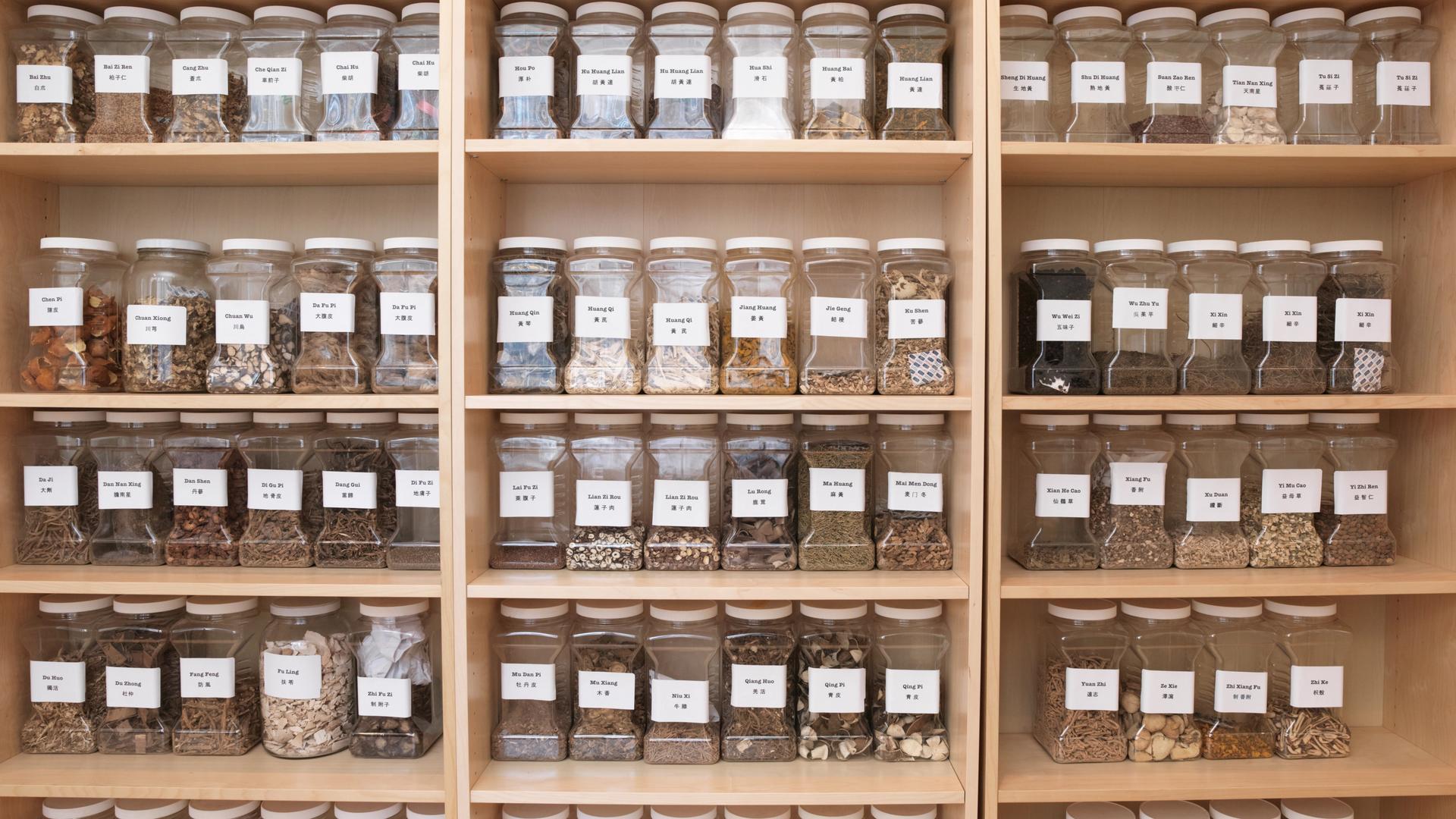
Chinese Herbal Medicine
Herbs, supplements, tinctures, and the Materia Medica
Herbal medicine is the other principal branch of Chinese medicine. Acupuncture works treatment by treatment, stimulating the body’s own regulatory responses; herbs continue that work between visits and can address some patterns that acupuncture alone may change more slowly. When the two are appropriate together, they are complementary — which is why herbal medicine is often prescribed as part of a course of acupuncture rather than treated as something separate.
What Chinese herbal medicine is
The Chinese materia medica is one of the world’s great accumulated bodies of medical knowledge. Over roughly two thousand years, several thousand substances — predominantly plants, together with minerals and a smaller number of other materials — have been identified, classified, described, and recorded in medical use. A few hundred remain in routine clinical practice today.
Herbs are rarely prescribed one at a time. The basic unit of Chinese herbal medicine is the formula: a carefully structured combination in which different ingredients perform different roles. One or two may provide the principal action; others reinforce it, direct the formula toward a particular part of the body, temper an ingredient that would otherwise be too strong, or address an accompanying symptom. Change an ingredient or alter the proportions and the character of the prescription changes with it.
Several hundred classical formulas have been transmitted through the medical tradition, but they are starting points rather than fixed prescriptions. A practitioner may begin with a formula that has been used for centuries and then modify it substantially for the person sitting in front of them.
The herbalist’s skill lies in understanding three things at once: the actions of the individual substances, the way they behave in combination, and the particular pattern being treated. That last distinction matters most. Two people may arrive with the same Western diagnosis and leave with entirely different prescriptions because what has produced the complaint, and what accompanies it, is different in each.
How a formula is prescribed for you
Herbs are prescribed from a diagnosis, not simply matched to a symptom.
That diagnosis begins at your first appointment, using the same detailed history, pulse reading, and tongue examination that guide your acupuncture treatment. We look at the complaint that brought you in, but also at the larger picture — sleep, digestion, appetite, energy, temperature, stress, menstrual or hormonal patterns where relevant, and the other details that help distinguish one presentation from another.
If herbal medicine is likely to be useful, we discuss it with you at the end of the appointment.
The prescription you receive is written for you. We take into account your constitution, the pattern underlying the condition, and every medication and supplement you already use. We then revise the formula as the picture changes. This is an ordinary part of herbal treatment rather than an indication that the first prescription was wrong. A formula appropriate during an acute phase may be entirely inappropriate six weeks later, once the acute symptoms have resolved and a different aspect of the condition has become more important.
That ability to follow the condition as it changes is one of the principal advantages of working with an herbalist rather than remaining indefinitely on a fixed over-the-counter formula.
Bring a current list of everything you take — prescription medication, over-the-counter drugs, vitamins, herbs, and supplements. It is one of the first things we ask for.
The forms herbs come in
Chinese herbal formulas can be dispensed in several forms. The choice is partly clinical and partly practical.
- Raw herbs — the traditional preparation, cooked at home into a decoction. The most flexible form and, for many conditions, the most effective, since the formula can be written and rewritten herb by herb. It also takes time to prepare and does not taste pleasant.
- Granules and powdered extracts — herbs extracted and dried into a powder that dissolves in hot water. Close to the flexibility of raw herbs, with none of the cooking.
- Pills and tablets — prepared classical formulas from premium manufacturers, in fixed combinations. The most convenient form, and what most people take when a standard formula fits the case well.
- Tinctures, liniments, and topical preparations — used where they suit the complaint, and in cosmetic and dermatological work.
We will recommend the form we think best suited to the treatment, but practicality matters. If making a decoction twice a day bears no resemblance to the life you actually lead, tell us. A slightly less elaborate prescription that is taken consistently is considerably more useful than a theoretically perfect one left untouched in the kitchen.
Herbs and your other medication
Chinese herbal medicine is pharmacologically active. That is part of why it can be useful, and also why it should be prescribed with care rather than selected casually from a shelf.
Herbs can interact with prescription medications. Anticoagulants, immunosuppressants, and certain psychiatric and cardiovascular drugs require particular attention, and there are circumstances in which an herb, a class of herbs, or herbal treatment altogether may be inappropriate. An experienced herbalist works with those considerations from the beginning rather than treating them as an afterthought.
Bring us a complete list of everything you take, including supplements and occasional medications. We write the formula with that list in view.
Tell us if you are pregnant, trying to conceive, or breastfeeding; if you have liver or kidney disease; or if you have surgery scheduled. These circumstances do not necessarily rule out herbal treatment, but they alter what can be prescribed and, in some cases, when it should be paused.
Where our herbs come from
An herbal prescription is only as reliable as the substances from which it is made, and quality across the international herbal supply chain varies considerably. We therefore buy from established suppliers who manufacture under current Good Manufacturing Practice standards and document the products they supply.
Our herbs are tested for heavy metals, pesticide residues, microbial contamination, and adulteration, and are identity-verified to confirm that the correct botanical species has been supplied. We do not use endangered species or products derived from them.
For us, sourcing is part of prescribing. Knowing what an herb is supposed to do is not enough; we also need to know that what reaches the patient is actually the herb named on the prescription and meets an appropriate standard of purity.
Experience
Herbal medicine is one of the most demanding parts of Chinese medicine to practice well. The materia medica is large, formula construction is complex, and safe prescribing requires a working knowledge not only of traditional diagnosis but of medications, interactions, and the ways a prescription needs to change over time. Not every licensed acupuncturist makes herbal medicine a major part of clinical practice.
We have prescribed herbs here since the practice opened in 1999.
Adele Reising holds a Master’s in Traditional Oriental Medicine from Pacific College of Oriental Medicine, now Pacific College of Health and Science. She began teaching there in 1999 and chaired the Herbal Medicine department from 2000 to 2004. Her studies have also taken her to Beijing, including work on Ming-dynasty medical texts supported by a Blakemore Foundation grant, as well as classical study of the Huang Di Nei Jing and advanced training in the classical traditions.
That background matters because herbal medicine rewards depth. A good prescription is not simply a collection of ingredients associated with a symptom; it depends on recognizing a pattern, knowing the tradition well enough to choose an intelligent starting point, and knowing when and how to depart from it.
Buying herbs and supplements
Prescribed formulas are dispensed through the practice. A selection of our prepared formulas, supplements, and topical preparations is also available to buy directly, without an appointment.
Prepared formulas can be very useful when the pattern is straightforward and the product is well suited to it. For persistent, complicated, or unexplained symptoms, however, an individualized assessment is usually the better place to begin.
Fees
There is no separate consultation fee for herbal medicine when it is prescribed as part of your treatment; you pay for the herbs themselves. Costs vary according to the ingredients, the form of the prescription, and how long it is intended to last, and we tell you what to expect before anything is dispensed.
Common questions
Do I have to have acupuncture to be prescribed herbs?
Herbs are usually prescribed as part of a course of treatment, following a full diagnosis. If you want herbal medicine on its own, book an initial consultation and say so when you book.
How long will I take a formula for?
It depends on the complaint. Acute problems may need one to two weeks. Chronic conditions are usually treated over months, with the formula revised along the way. We won't leave you on the same prescription indefinitely without reviewing it.
How bad do they taste?
Raw decoctions are an acquired taste, and most people never acquire it. Granules are milder. Pills and tablets taste of nothing. If taste is the obstacle, say so — there is almost always another form.
Are Chinese herbs safe?
Prescribed by a trained herbalist, from tested sources, and with your medications accounted for, they have a good safety record. The risks come from unsupervised use, undocumented sourcing, and undisclosed drug interactions — which is what the consultation is for.
Can I take them while pregnant or breastfeeding?
Some formulas are used in pregnancy and others are specifically avoided. Tell us at the outset so the prescription is written accordingly.
Will they interact with my prescriptions?
They can. Bring a complete list of what you take, including supplements, and we prescribe around it — or advise against herbs if that is the right call.
Can I just buy a formula I have read about?
You can buy prepared formulas from the shop, but a formula that suits someone else's pattern may do nothing for yours, or work against it. If you are treating a real complaint, get assessed first.
Do you use animal products?
No endangered species or products derived from them. Tell us if you want a formula written free of all animal-derived ingredients.