
Our philosophy
How we understand Chinese medicine, and integrate it into a holistic approach to health

The body as microcosm of the world
Chinese medicine is predicated on a fundamental premise: that we are made on the same pattern as everything around us, and that what governs the natural world governs the body.
The heart is the sun. The lungs are the sky and the air that moves through it. Digestion is the soil. The liver is the green regenerating growth of the earth, and the kidneys its salt oceans. These are not decorations laid over anatomy — they are the working model. Two thousand years of clinical medicine were built by studying the natural order and applying what it teaches to the inner workings of a person, and the correspondences have held up remarkably well.
They are organized as the five phases: wood, fire, earth, metal, and water, each with its season, its climate, its direction of movement, and its part of the body. A practitioner reading a case is reading which of them is in excess, which is depleted, and how they are failing to pass movement between them.

What that looks like in a diagnosis
Insomnia, in this system, is the sun failing to reach the ocean — heart and kidney out of communication, so that the fire which should bank down at nightfall stays up in the sky. A disordered gut is earth out of condition: soil that has lost its capacity to take things in and turn them into what the rest of the body needs.
A diagnosis of this kind names a relationship rather than a part, which is why two patients arriving with one complaint are so often treated in opposite directions, and why we ask you about your sleep when you have come in about your knee.
Qi and the channels
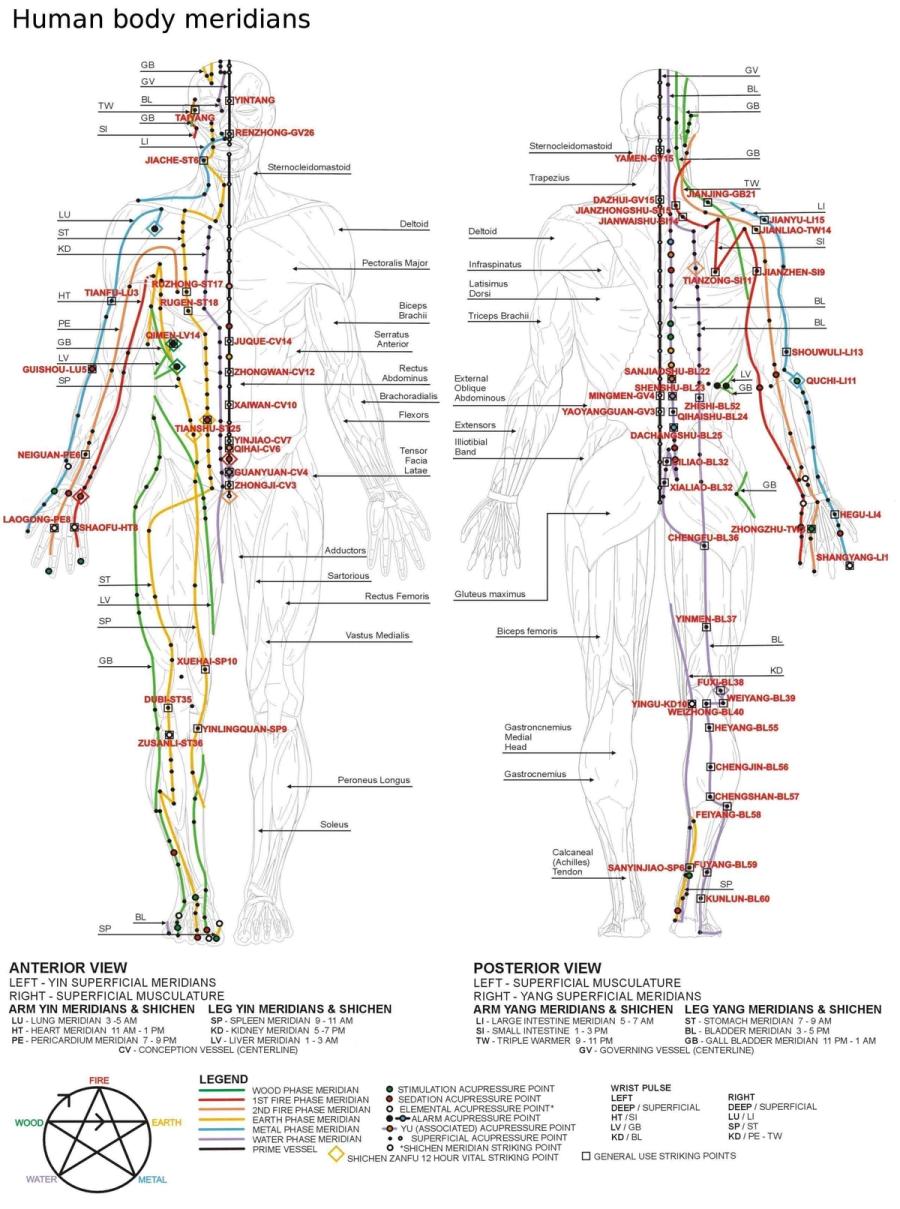
Qi — pronounced chee, and best rendered as the body's motive force — moves through a system of channels running the length of the body, in the way that rivers cross a country toward the sea.
Where a river silts up or runs shallow, everything downstream suffers for it. The body knows perfectly well how to keep itself well; when the movement is obstructed or weak, it cannot do what it knows, and illness follows. The points along those channels are where the movement can be reached. Needles fine enough that most people barely register them restore it, and the body resumes.


Root and branch
Chinese medicine treats the branch and the root — biao and ben.
The branch is the symptom: the pain, the rash, the three o'clock waking, the flare. The root is whatever is producing it. Treating the branch alone brings relief that lasts until it doesn't. Treating the root alone leaves you in pain while you wait. We do both, in the same course of treatment, and it is the reason our patients tend to find that things other than the complaint they came in with have quietly improved as well.
A complete medical system
Chinese medicine is not a therapy for one category of problem. It is a complete medical system, with its own diagnostics, its own pharmacology, and its own logic, and it has been treating the full range of human illness for two millennia.
We treat a great deal of pain — back, neck, joints, injuries, migraine. We also treat allergies and sinus disease, gynecological disorders and infertility, digestive conditions from reflux to irritable bowel, skin complaints, insomnia, anxiety, and the exhaustion that no one has been able to account for.
Where a condition is being managed by a physician — an autoimmune disease, asthma, a chronic illness under specialist care — we work alongside that treatment rather than in place of it, and we are glad to coordinate with the people directing it.
Where Chinese medicine particularly excels is the chronic and the complex: the conditions that have been thoroughly investigated without producing an answer, the ones for which the available treatment manages symptoms and little else, and the ones you have been told to live with.

Herbal medicine
Chinese herbal medicine is among the oldest medical traditions still in continuous practice, and it remains one of the most sophisticated. We prescribe both prepared classical formulas and formulas written for the individual patient and revised as they change.
Acupuncture and herbs together work faster than either alone. Acupuncture treats weekly; a formula treats every day in between.
A generation of care in the heart of Manhattan
We have been practicing this way in New York since 1999, with the conviction that a medical tradition which studies the order of the natural world has something particular to offer people who live in a city.