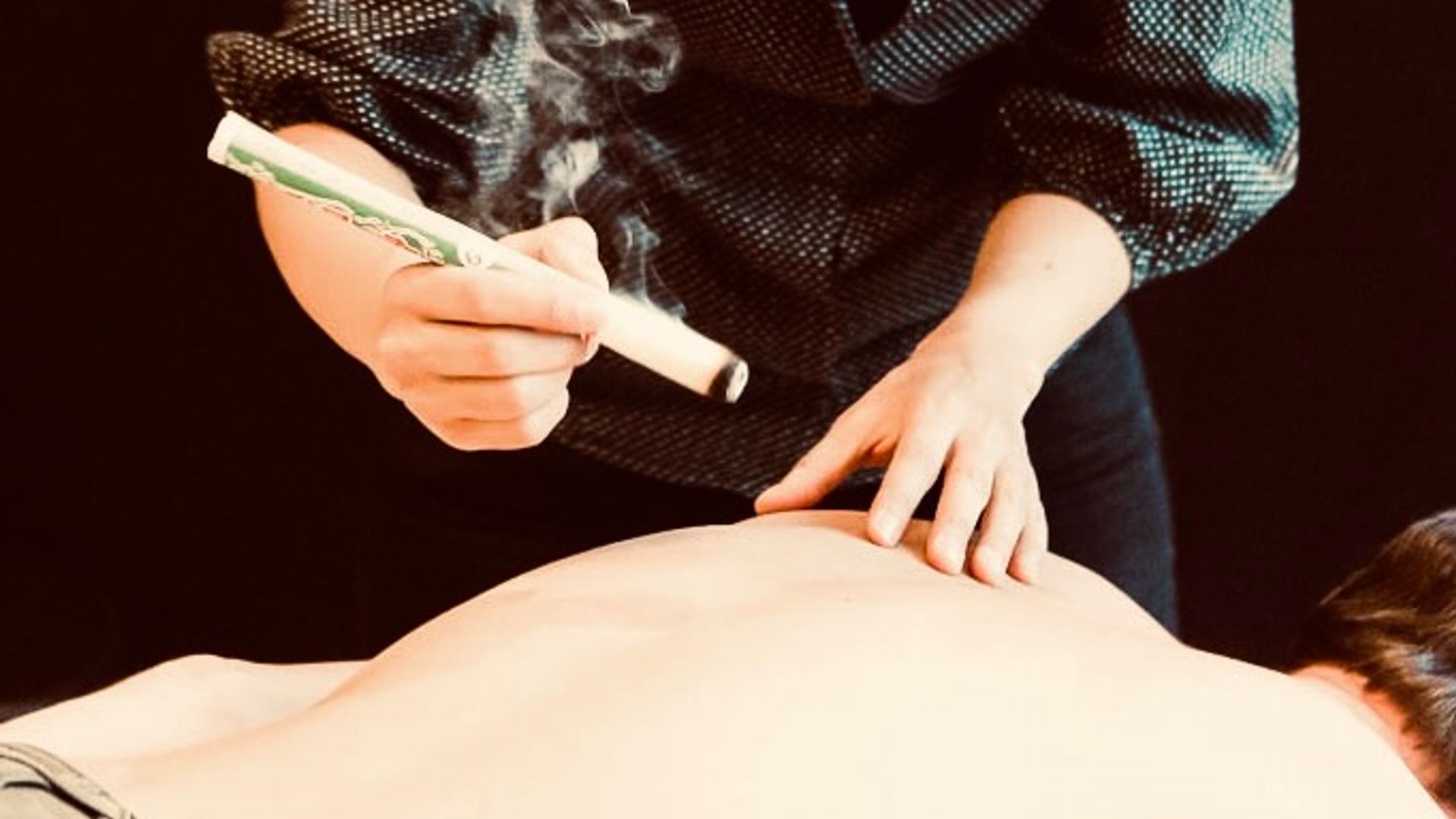
Moxibustion
Warms, restores, and supports the body’s vitality
Moxibustion is the warming half of Chinese medicine, and the half many people encounter only after they begin treatment. It uses the heat of a specially prepared herb, burned at a controlled distance from the skin or applied over acupuncture points using small protective bases.
Where needling regulates and moves, moxa warms, moves, and nourishes. It is also one of the most immediately pleasurable treatments we offer: a slow, penetrating warmth that can feel remarkably restorative, particularly in a body that has been cold, stiff, depleted, or slow to recover.
Needle and moxa
The Chinese word commonly translated as acupuncture is zhēnjiǔ — 針灸 — literally “needle and moxa.” The second character, 灸 (jiǔ), refers to moxibustion.
That matters, because moxa is not an accessory that was subsequently added to acupuncture. Needling and moxibustion are named together in Chinese medicine and have been practiced alongside one another for centuries. There are classical patterns and conditions for which warming with moxa, rather than needling alone, is particularly appropriate.
In a modern treatment room the acupuncture needle may be more familiar, but historically it has only ever been part of the picture.
What is moxa?
Moxa is made from Artemisia argyi, Chinese mugwort, known in the Chinese materia medica as ài yè (艾葉). The leaves are dried, aged, and repeatedly processed until what remains is a soft, fine fiber known as moxa wool or moxa punk. This is the material that is burned.
The quality of moxa matters. Well-aged, finely processed moxa burns slowly and evenly and allows the practitioner to produce a gentle, controlled warmth.
How is moxa applied?
In our practice, we primarily use two forms of indirect moxibustion: Japanese stick-on moxa and pole moxa. Which we choose depends on the area being treated and whether we want to warm specific acupuncture points or a broader region.
Japanese stick-on moxa allows us to warm individual acupuncture points very precisely. Small, pre-formed pieces of moxa sit on a protective adhesive base and are placed over selected points. They burn gradually, producing a concentrated warmth without the burning moxa coming into direct contact with the skin.
Pole moxa is held several centimeters above the skin, either over a particular acupuncture point or moved slowly over an area. The warmth builds gradually and can be used over areas such as the abdomen, low back, joints, or regions of muscular tension.
Both techniques allow us to control the intensity of the heat carefully. The method we use depends on the points being treated and the kind of warming effect we want to produce.
What does moxibustion feel like?
Moxa produces a deep, spreading warmth that can seem to sink into the body rather than simply heating the surface. One of its more interesting effects is that the sensation of warmth does not always remain where the moxa is being applied. At times, patients can feel it travel some distance along the acupuncture channel being treated — a spreading line of warmth extending into another part of the body.
The heat develops gradually, and we ask you to tell us as it becomes stronger. Treatment is guided by your response rather than by a predetermined amount of time. The aim is a comfortable, penetrating warmth, never burning or discomfort.
Traditional moxa also has a distinctive herbal, smoky scent. Many patients come to associate the smell with treatment and grow rather fond of it.
What is moxibustion used for?
In Chinese medicine, moxa is particularly useful when a condition has a quality of cold, stagnation, or depletion. These are often problems that worsen in cold or damp weather, feel better with warmth, or have been slow to resolve.
Moxa is not chosen simply because someone has a particular diagnosis. As with acupuncture and herbal medicine, we use it when the individual presentation suggests that warming is appropriate.
Joint pain and stiffness
Pole moxa can be particularly wonderful for painful, stiff joints, including the hip, knee, and shoulder. Unlike a heating pad, which primarily warms a broad surface area, the heat from pole moxa is focused and gradually builds over the area being treated. Patients often describe the warmth as penetrating surprisingly deeply, and it can be especially soothing for an old injury or an aching joint that feels noticeably better with heat.
We sometimes think of moxa as an ancient precursor, in spirit, to the deep warming therapies now associated with far-infrared heat. Chinese medicine developed its own method of delivering sustained, focused warmth to painful or depleted areas centuries before we had machines designed to do something similar.
For the right kind of joint pain, it is also simply a lovely treatment to receive. The warmth builds slowly, muscles around the joint begin to relax, and an area that has felt cold, tight, or stubbornly stiff can feel considerably freer afterward.
We also frequently use moxa after Plum Blossom treatment for chronic tendon problems, areas of long-standing muscular restriction, and adhesions. Plum Blossom helps stimulate and mobilize an area that has become particularly fixed or resistant to treatment; following it with pole moxa brings a deep, sustained warmth into the tissues. We find the combination particularly useful for old injuries and stubborn areas of restriction that have been present for a long time.
Menstrual and gynecological complaints
Moxa can be especially useful for menstrual pain and cramping that improve with heat, as well as certain patterns of irregular menstruation and during fertility treatment. Warming the lower abdomen has a long history in Chinese gynecology.
Breech presentation
Pole moxa applied to an acupuncture point near the outer corner of the little toe is a traditional treatment used to encourage a breech baby to turn. We generally recommend beginning treatment around 32–34 weeks, when there is still room for the baby to move.
We will teach you how to use the moxa safely at home so that treatment can be continued between visits, but we also recommend coming in for acupuncture and moxibustion during this period. There is a difference between simply applying heat to a point and having the treatment performed and adjusted by an experienced practitioner.
Treatment may also be useful in the period leading up to an external cephalic version (ECV).
Digestive complaints
Moxa can be particularly useful for digestive complaints that have a cold or depleted quality: bloating, loose stools, poor appetite, or abdominal discomfort that consistently feels better with warmth. Depending on the presentation, we may use moxa over particular acupuncture points or gently warm the abdomen with pole moxa.
Fatigue and rebuilding
We often use moxibustion toward the end of an acupuncture treatment when someone is particularly fatigued or depleted. This can be especially helpful during a long recovery from illness, including patients with Long COVID or chronic fatigue, or when someone simply has very little reserve. When appropriate, we may also teach you a simple moxa treatment to continue safely at home between visits.
One of the most important points for this purpose is Stomach 36, Zu San Li (足三里), a point just below the knee. Its name is traditionally translated as “Leg Three Li.” A li is an old Chinese measure of distance, and there is a traditional saying that treating Stomach 36 with moxa gives a weary traveler the strength to walk another three li.
It is a lovely description of how the point has been understood for centuries. Stomach 36 is one of Chinese medicine’s great strengthening points, traditionally used to support digestion, vitality, stamina, and recovery. Moxibustion at this point is also traditionally used when someone is weak or depleted, including patterns associated with anemia.
Anemia and low blood counts
In practice, we have also used moxa as supportive care for patients with anemia and other low blood counts. This may include anemia associated with heavy menstrual bleeding as well as patients whose blood counts have fallen during cancer treatment.
Moxibustion is used alongside appropriate medical evaluation and treatment, not in place of it. Our aim is to support the body’s recovery while conventional care addresses the underlying cause and monitors the blood counts.
Can I do moxa at home?
Yes, in some circumstances. Moxibustion is unusual among the techniques we use because there are simple forms that we can teach patients to continue at home.
This is particularly useful when repetition is part of the treatment strategy, as it often is with breech presentation or when using moxa to support someone who is fatigued or depleted. We will show you which point or points to treat, how to use the moxa, how much warmth we are looking for, and how often to do it.
Home moxa should be something we have specifically recommended and demonstrated for you rather than a treatment undertaken from a general set of instructions.
Is moxibustion safe?
Moxibustion is generally very safe when performed by a trained practitioner. Because it involves heat, the principal risk is a burn, and careful technique is designed to prevent one. Burning moxa is never left unattended, and we rely on both visual monitoring and your feedback about how the warmth feels.
Please tell us if you have reduced sensation from neuropathy, diabetes, nerve injury, or another condition, since you may not perceive increasing heat normally. We generally avoid applying moxa over areas with significantly impaired sensation, broken or inflamed skin, or when heat would be inappropriate for the condition being treated.
Please also tell us if you are pregnant, have asthma or significant sensitivity to smoke, or currently have a fever so that treatment can be adapted appropriately.
Our treatment rooms are ventilated.
Do I need to book moxibustion separately?
No. Moxibustion is one of the tools of Chinese medicine, and we incorporate it into an acupuncture treatment whenever we think it will be useful. There is no additional charge and no separate treatment you need to book.