Acupuncture
How it works and what to expect
Acupuncture is at the center of what we do, and the reason most people first find their way to us. It is a medicine roughly two thousand years old, continuously developed in clinical practice since antiquity, and today one of the most closely studied therapies outside conventional Western medicine. It may also be the most restful hour of your week.
What it feels like
The thing we hear most often after a first treatment is that it was nothing like what the patient expected.
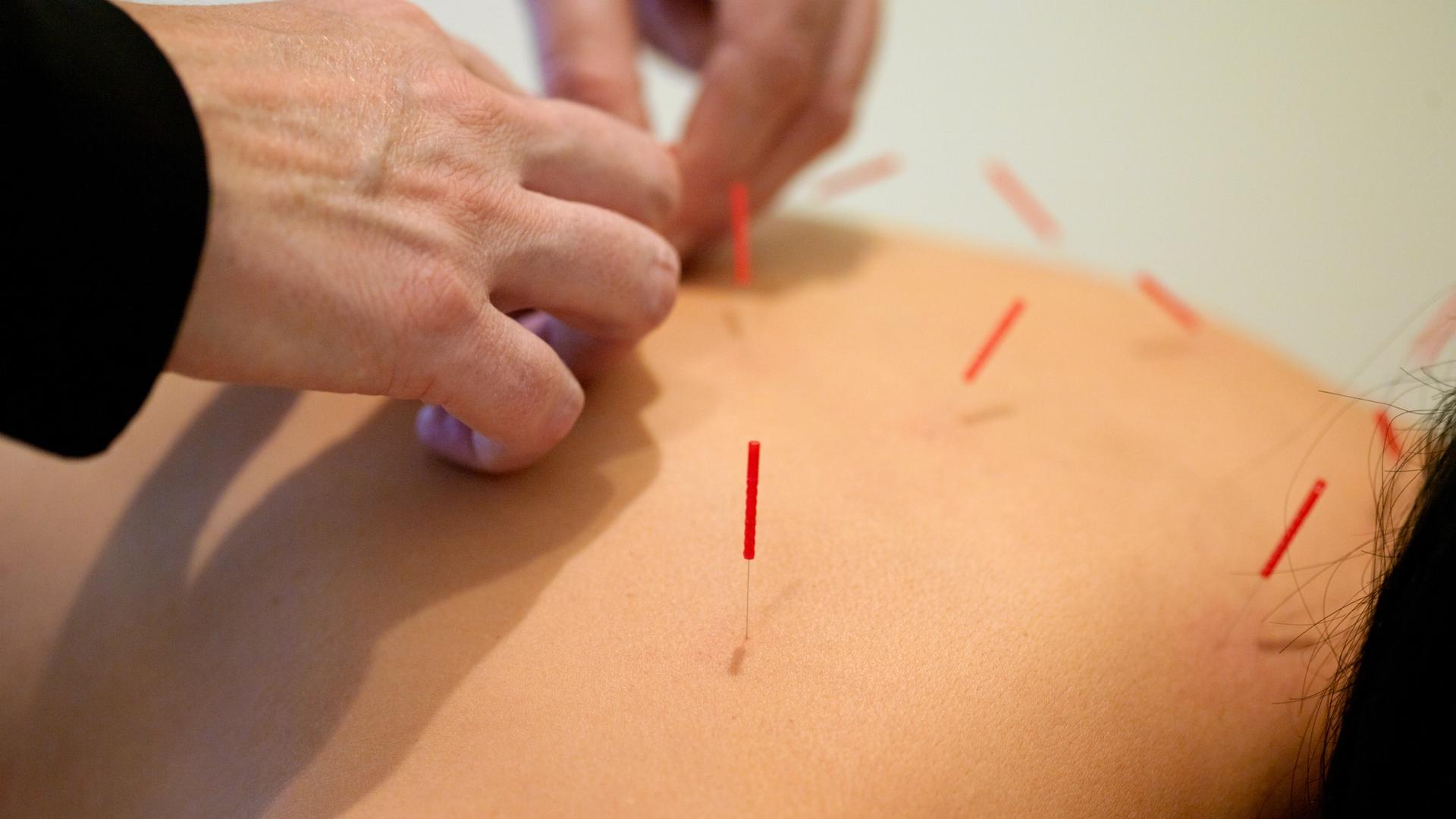
An acupuncture needle bears very little resemblance to the hollow needles used for injections or blood draws. It is solid rather than hollow, and so fine that several would fit inside the bore of a standard hypodermic needle — closer in gauge to a human hair. We use Japanese needles, which are finer still and exceptionally well finished. Every needle is sterile, used once, and discarded immediately after treatment.
You may feel a brief tap as a needle enters, or nothing at all. Once a point is engaged, there may be a dull heaviness, warmth, tingling, or a sensation that spreads gently around the needle. These sensations are usually brief. Anything sharp should be mentioned immediately; a needle can be adjusted or removed at once.
The needles then remain in place while you rest, usually for twenty to thirty minutes. Deep relaxation is common, and quite a few people fall asleep.
How acupuncture works
The Chinese medical framework
Chinese medicine describes a network of channels, or meridians, running through the body — mapped in the way the circulatory and nervous systems are mapped, though identical to neither. There are twelve principal channels, each associated with an organ and following a defined course from the trunk to the extremities. Eight further vessels, the 奇經八脈 qí jīng bā mài, run deeper and are understood to hold longer-term constitutional patterns. 氣 qì — pronounced chee— the body’s motive energy, moves through them, and 血 xuè, blood, moves with it.
Illness, pain, and the less easily defined states of simply not feeling well are understood as disturbances in that movement: an obstruction, a depletion, an excess, a system no longer regulating itself as it should. The categories are considerably more precise than the language of “balance” can sometimes make them sound. 痺 bì, obstruction, describes the fixed pain of an old injury or a stiff joint; the classical gloss is simply 痺者閉也, “bì is blockage.” Depletion of 氣 qì may present as fatigue that rest does not resolve. Heat may appear as thirst, irritability, disrupted sleep, and a red tongue. These are not decorative metaphors. They are the diagnostic terms in which the medicine is practiced.
The acupuncture points along the channels are where that system can be influenced. There are three hundred and sixty-one classical points on the principal channels, each with its own actions and clinical character: some move stagnation, some supplement what is depleted, some clear heat, some calm the mind. Their effects also change according to the combinations in which they are used. The skill lies less in the number of needles than in choosing the right points and putting them together intelligently. A point in the hand may be selected for a problem in the head because the channel connects the two.
This is why two people arriving with the same headache may receive very different treatments. One may have a pattern of heat rising, with pain aggravated by stress and relieved by cool air; another may have a depleted pattern, with headaches appearing when tired and worsening as the day goes on. The symptom is the same, but the diagnosis is not. Sleep, digestion, temperature, appetite, menstrual cycle where relevant, the pulse at both wrists, and the appearance of the tongue all contribute to the larger picture.
It is also why the first appointment takes as long as it does.
This is the language in which Chinese medicine has been thought and taught since the 黃帝內經 Huángdì Nèijīng was compiled roughly two thousand years ago. It has been refined continuously in clinical practice since then, and it remains the most precise account of what a traditionally trained practitioner is actually doing.
What contemporary research shows
Modern research approaches acupuncture from another direction. At present, it describes many of its physiological effects more clearly than it explains the treatment as a whole. The literature on mechanisms and the literature on clinical outcomes remain partly separate, and neither has yet provided a complete account of the other.
What is well established is that needling produces both local and systemic responses. At the site of insertion, acupuncture affects connective tissue and small nerve fibers and increases local blood flow. Adenosine accumulates in the tissue and appears to contribute to analgesia; mast-cell activity and other signaling processes contribute to local anti-inflammatory effects. Rotating a needle also mechanically deforms the connective tissue around it, a measurable response that helps explain why needle manipulation can matter and not simply needle insertion.
The effects extend beyond the point being needled. Functional imaging and clinical research show changes in the way pain signals are processed through the spinal cord and brain, including the dorsal horn, periaqueductal grey, and limbic and prefrontal regions involved in the experience and regulation of pain. Studies also show changes in autonomic activity toward greater parasympathetic regulation, measurable through heart-rate variability, together with the release of endogenous opioids and other signaling molecules associated with analgesia and well-being. The finding that naloxone can block part of acupuncture’s analgesic effect is one of the older and more firmly established observations in the field.
The honest position is that these effects are real and repeatedly measurable. What remains unsettled is precisely how much each contributes to the clinical result. The mechanism literature and the treatment-outcome literature have not yet converged into one complete explanation.
The evidence is strongest and most consistent for chronic pain — including musculoskeletal pain and osteoarthritis — for prevention of migraine and tension-type headache, and for nausea, including nausea after surgery and chemotherapy. The largest individual-patient-data analysis of chronic pain pooled thirty-nine trials and more than twenty thousand patients and found benefits that persisted after the course of treatment had ended rather than disappearing with it. Acupuncture is consequently included in a number of clinical guidelines, among them those of the American College of Physicians for chronic low back pain.
In other areas, the evidence is less settled: trials may be fewer, smaller, or less well designed, and we say so on the individual pages where that matters. What remains consistent in practice is that acupuncture has a strong safety record in trained hands, produces measurable physiological effects, and is a treatment to which patients return.
What people come to us for
People come to us with a wide range of complaints. Among the most common here:
- Pain and musculoskeletal problems — back and neck pain, sciatica, arthritis, sports and repetitive-strain injuries, recovery after surgery
- Headache and migraine
- Fertility, gynecology, and pregnancy — irregular cycles, painful periods, endometriosis, IVF support, perimenopause and menopause
- Stress, sleep, and mood — insomnia, anxiety, exhaustion, trouble concentrating
- Digestive complaints
- Allergies, sinus problems, and recurrent colds
- Support during cancer treatment — easing nausea, fatigue, neuropathy, and sleep
- Facial rejuvenation and skin — see Facial Rejuvenation Acupuncture
Your first visit
The first appointment lasts ninety minutes and is as much conversation as treatment.
We begin with a full history. That means the problem that brought you in, but also sleep, digestion, energy, appetite, temperature, stress, and — where relevant — your menstrual cycle. We read the pulse at both wrists and look at the tongue, both of which carry diagnostic information within Chinese medicine. The purpose is to understand not simply where something hurts or when a symptom began, but the larger pattern in which it is occurring.
Treatment is then built from that picture.
You will spend the remainder of the visit on the treatment table. It is best to eat something in the hour or two before your appointment, as treatment on an empty stomach can occasionally leave people lightheaded.
If herbal medicine would be useful, we discuss that at the end of the visit.
Follow-up appointments are shorter and concentrate primarily on treatment, with a brief reassessment each time. Symptoms change, and the treatment changes with them.
A typical course of treatment
Acupuncture is cumulative. A single session may bring noticeable relief, but the changes that last are generally built over a series of treatments.
A typical course is ten sessions, usually beginning weekly. If a problem is acute or particularly severe, we may recommend twice-weekly treatment at first and then increase the interval as things settle. Chronic conditions — particularly those that have been present for years — may require more than one course. As a broad rule, the longer a pattern has been established, the more time it is likely to take to change.
We set out a treatment plan at the first visit and revise it according to your response. The purpose is not to keep treating indefinitely without knowing whether anything is changing. If acupuncture does not appear to be the right treatment for you, or if you are not progressing in the way we would expect, we tell you — and we tell you early.
Coming in when nothing is wrong
You do not need to be ill or in pain to book acupuncture. Some of our longest-standing patients come because regular treatment simply leaves them feeling better.
A good treatment often produces a recognizable combination of effects: the body feels lighter, the mind clearer, tension has dropped, and there is more energy without the accompanying sense of being wound up. Once an active course of treatment is complete, maintenance visits are much less frequent. Monthly treatment works well for many people; others come with the change of seasons or when they notice themselves beginning to slip out of equilibrium. We help you find an interval that makes sense for you.
Regular treatment also has a way of bringing other things into view. People mention poor sleep, monthly cramps, allergies, headaches, or a mind that never quite settles almost in passing, not realizing that these are things we may also be able to address.
There is another practical advantage to being an established patient: when something acute happens, you already know where to come. A turned ankle, a flare of back pain, a sinus problem, or a cold that has moved into the chest is generally better addressed early than after a week of waiting to see what happens. Being able to come in promptly can make the difference between dealing with something while it is still small and treating it after it has become established.
Safety
Acupuncture has a strong safety record when practiced by a licensed acupuncturist. Every needle used here is sterile and individually packaged, used once, and placed directly into a sharps container after removal. Nothing is ever reused.
Side effects are generally minor and short-lived: slight soreness at a point, a small bruise, or occasional lightheadedness. All of our practitioners are licensed by New York State and board certified by the NCCAOM.
Tell us if you are pregnant or may be pregnant, if you take blood thinners or have a bleeding disorder, if you have a pacemaker or another implanted medical device, or if your immune system is compromised. None of these necessarily prevents treatment, but each affects how treatment should be planned.
Common questions
Does it hurt?
Usually not. You may feel a brief tap as a needle goes in, followed by a dull or spreading heaviness once the point is engaged. Anything sharp should be mentioned immediately, and we adjust the needle straight away.
How many needles will be used?
It varies according to the treatment, but usually somewhere between six and twenty. More is not better. The choice of points matters much more than the number.
How long do the needles stay in?
Usually twenty to thirty minutes, while you rest.
Is it safe during pregnancy?
Yes, with a practitioner trained in treating pregnancy — certain points are avoided. Tell us at the outset.
Can I have acupuncture while taking medication or during cancer treatment?
Yes. It works well as part of your conventional care. Bring a list of your medications and tell us about any ongoing treatment, so we can plan your treatment accordingly.
Do you take insurance?
We are out-of-network and will check your coverage on request. Fees and insurance
Can I combine acupuncture with massage?
Yes, and it's a common combination. Combined appointments can be booked online.
How soon will I feel something?
You may notice a change after the first treatment — often in sleep, tension, or general well-being before the presenting complaint itself changes. More durable improvement usually develops over a series of visits.